Sunday, March 06, 2011

Gem Spotting

There's not a lot of money in short stories, so it's not surprising that the short story doesn't receive as much attention as novels do, but some of the best SF published still comes in that format. Many magazines have excellent editors, so the stories are at least quite good, and often they are amazing. Authors may also be invited to contribute to anthologies. Those can be veritable treasure troves.

Some authors publish enough of these gems that they will in turn be published as a separate anthology. I love it when I come across these collections, because they will almost invariably be some of the most satisfying reading I'll do all year.

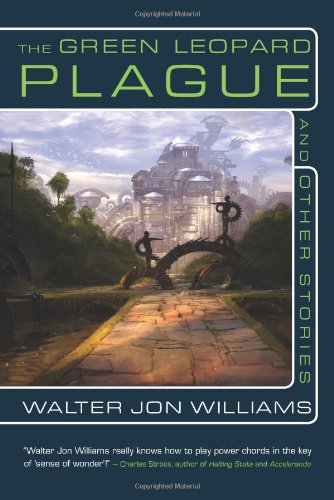
Walter Jon Williams's collection The Green Leopard Plague is a fantastic anthology of nine of Williams's best short stories. They range from a disturbing view of future childhood, "Daddy's World," to a raucous buddy-adventure, "Send Them Flowers." "Incarnation Day" and "Pinocchio" also deal with growing up, taking place in a future that Williams describes as a world "where everything went right." Of course in Williams's utopias there's still plenty of room for excitement, drama, and even tragedy. There's a man who has lost his true love to a rare incident of permanent death, "Lethe," a couple celebrating their 1,000th wedding anniversary, "The Millennium Party," and treasure hunting in the China Sea, "The Tang Dynasty Underwater Pyramid." The book's titular story, "The Green Leopard Plague," is one of this utopia's origin stories, a fantastic braiding of two points of view. "The Last Ride of German Freddy" is an alternate history fiction, re-imagining some of the events surrounding the fight at the OK Corral.

Each of the stories comes with a brief post-script by Williams, explaining some of the story's genesis, and adding even more to its enjoyment.

I wish I could promise you that all single-author anthologies are going to be as satisfying as The Green Leopard Plague, but at least I can promise you that this particular collection will be some of the best reading you'll do.

Labels: , ,

Thursday, January 27, 2011

The Sincere Sense

In 2008, when SF Worldcon was held in Denver, probably one of the best panels was "Believers versus Skeptics." Arrayed were leading lights of the skeptical world like Michael Shermer against notorious believers like Patrick Burns. The believers tried to lead off by redefining the word "skeptic," but soon discovered they were talking to a hostile room, and quickly found themselves busy retrenching their position. They weren't really believers in the paranormal. They were just regular scientists who thought that there might be alternative explanations to account for bumps in the night or vague voices in the static, or so they said. Just why there needed to be alternative explanations, they couldn't answer.

The point was, of course, that the basic paradigm of science is that everything there is in this universe is matter and energy, and we can always measure its existence. As Lord Kelvin said, if you can't measure it, then it didn't happen.

But suppose there is something out there that we can't measure for some reason. Dark matter sure turned out to be difficult to find. We can see its effects on galaxies out in space. Large enough clumps of it distort space enough to bend the light shining from galaxies behind it. It's massive enough to account for most of the matter in the universe. But we haven't been able to find it in the laboratory, in spite of a couple of decades of efforts and hundreds of millions of dollars spent. Can we even imagine what something might be that none of our instruments have so far been able to detect?

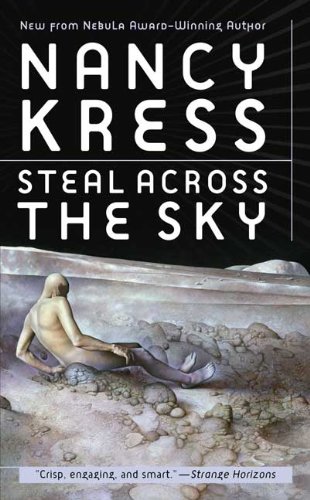
Nancy Kress refers to Helen Keller's experience as a blind person in her story Steal across the Sky. Can a blind person even imagine such a thing as light? In Nancy Kress's story aliens announce themselves to all the Earth. They're the Atoners, and they're looking for some volunteers to witness to a crime the Atoners committed against humanity. Eventually six crews of three volunteers each are assembled and go out among the stars to visit twelve human colonies, people the Atoners kidnapped from Earth about 10,000 years ago. They stay long enough to discover the incredible: once upon a time people could see the spirits of the recently dead, and even were able to talk to them. The Atoners then admit that in fact that was the situation. When these people were kidnapped, those who remained behind on Earth were sterilized, all, except for a few whose genes had been modified to take away their ability to see spirits.

Kress actually takes pains to present evidence to suggest that such a thing would be scientifically plausible. This is, after all, not a ghost story. The news has put people on Earth into an interesting position. People who already believe in spirits might have their faith confirmed. Some believe that this apparently scientific confirmation takes away from the miracle of life after death, and some even believe the Atoners represent the devil. Scientists are considerably more skeptical, and believe that the witnesses were somehow fooled by the Atoners.

I found the story to be well written. Kress uses an earnest tone throughout, and her story kept me interested in what would happen next, and I was definitely guessing until the very end which direction the story would take.

But I was left holding the bag.

Instead of dealing with the scientific consequences of being able to contact spirits, Kress allows the story to devolve into a kind of intrigue. Her characters get involved in a number of mostly unexplained intrigues, and in the end the reader is confronted with the Atoners' final action pretty much as a fait accomplis. I've run into those kinds of stories before. It's the sort of story that makes you think that the author got a call from her editor, demanding a finished manuscript, so she added a few more sentences and sent it off.

I still think it's worth reading, since it discusses an interesting aspect of the problem of what we know, and how we know it. But I think it could have been better.

Labels: ,